Type d'activité :
- Pêche
CITEB, Magasin no10 - Port Ouest, 97420 Le Port, Île de la Réunion
Chef de projet :
Evgeny ROMANOV


La pêche des céphalopodes pélagiques offre de nouvelles possibilités de développement économique. Il semblerait que leurs traits d’histoire de vie les rendraient moins sensibles à l’exploitation que d’autres ressources halieutiques. La majorité des céphalopodes ont un cycle de vie très court (<1 an) mais avec une vitesse de renouvellement de biomasse élevé. Les stocks mondiaux de céphalopodes sont actuellement en augmentation, tout comme leur exploitation.
Dans l’océan Indien, les prises annuelles de céphalopodes estimées sont passées de 250 000 tonnes en 2000 à 400 000 tonnes en 2016. Jusqu’à présent il n’y a pas d’exploitation de cette ressource dans les eaux réunionnaises et ce sujet a fait l’objet de peu de recherches appliquées.
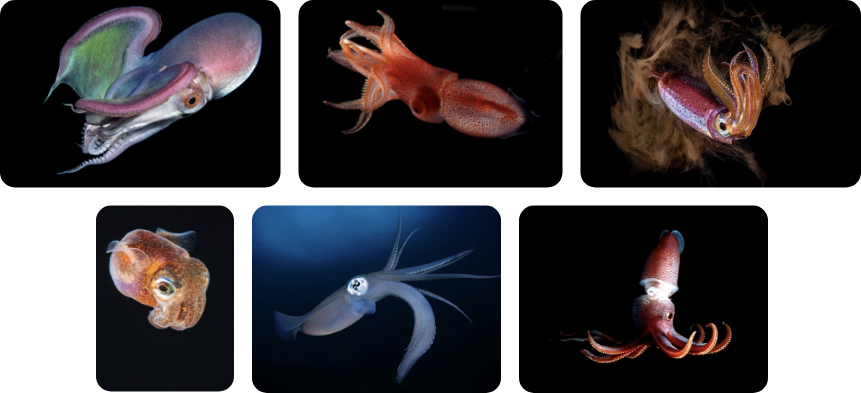
DECAPOT est un projet ayant pour but d’étudier de la diversité des calmars, les caractéristiques de leurs populations et l’évaluation des potentiels commerciaux de certaines espèces.
Quelles espèces de céphalopodes habitent dans les eaux réunionnaises?
Quel est le potentiel commercial de cette ressource?
Comment exploiter cette ressource tout en préservant la biodiversité et l’état des stocks?
Objectifs :
🦑Évaluer et étudier la diversité en calmars dans le milieu pélagique de La Réunion,
🦑Créer une liste de référence de ces espèces, et identifier les espèces rares et emblématiques,
🦑Évaluer l’importance des eaux réunionnaises en tant qu’habitat clé de ces espèces,
🦑Améliorer les connaissances sur la biologie et l’écologie des principales espèces présentes dans les eaux réunionnaises (cycle de vie, rôle dans les réseaux trophiques)
🦑Évaluer le potentiel halieutique des espèces communes et abondantes et travailler sur une filière « pêche artisanale de calmars »
🦑 Travailler sur une diversification des métiers de la pêche et ainsi offrir de nouvelles opportunités de développement pour les pêcheurs artisans, tout en diversifiant l’offre en produits de la mer pour les consommateurs.
Pêche exploratoire de calmars à La Réunion :
Dans le cadre de ses missions de soutien à la filière de pêche et d’acquisition de connaissance, le Citeb a fortement axé le projet sur la recherche d’une technique de pêche innovante permettant de cibler les calmars pélagiques.
Description de l’engin de pêche utilisé
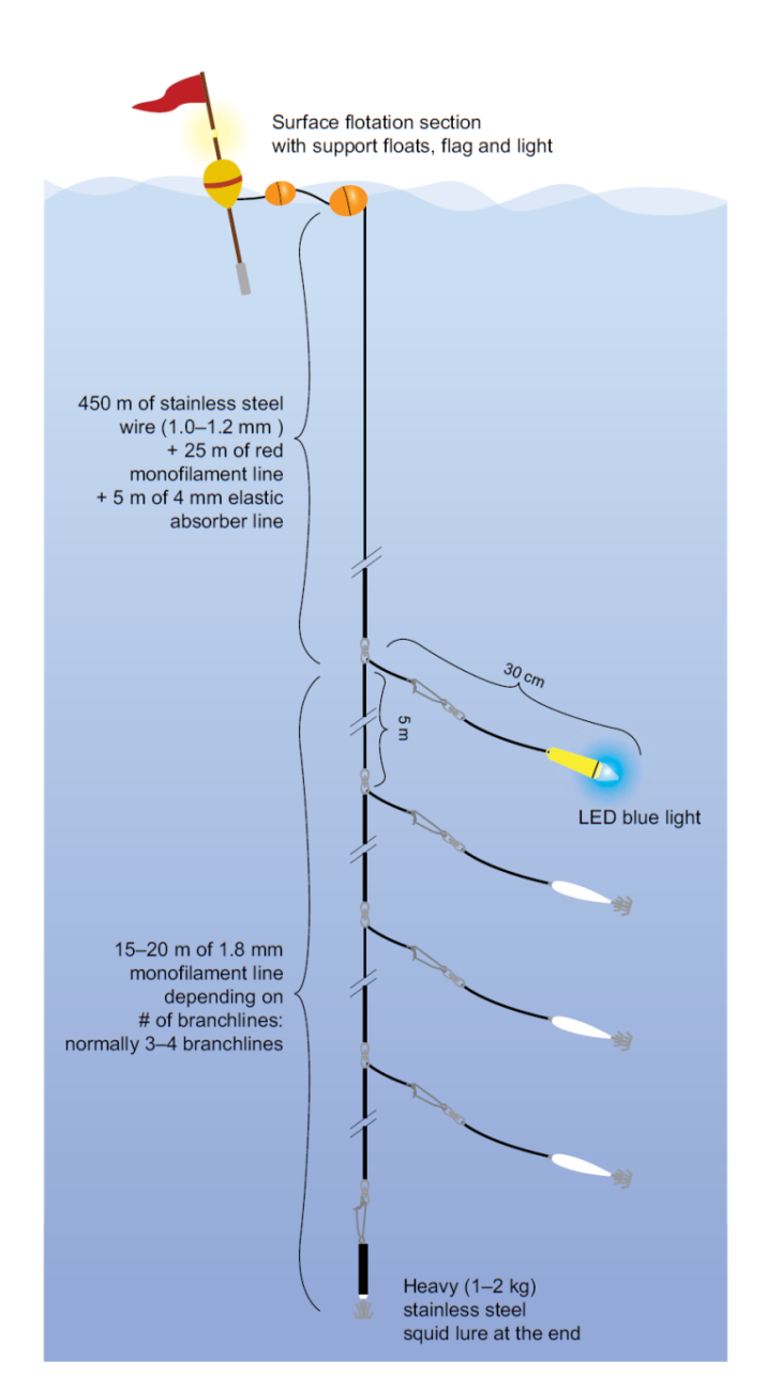
- ➔ Engin de pêche utilisé dans le Pacifique : ligne verticale à turluttes (‘taru-nagashi’), plus d’informations ici
- ➔ Test de faisabilité de la pêche de calmars à bord d’un navire de pêche côtière de moins de 12m, entre 3-7 palangres par sortie
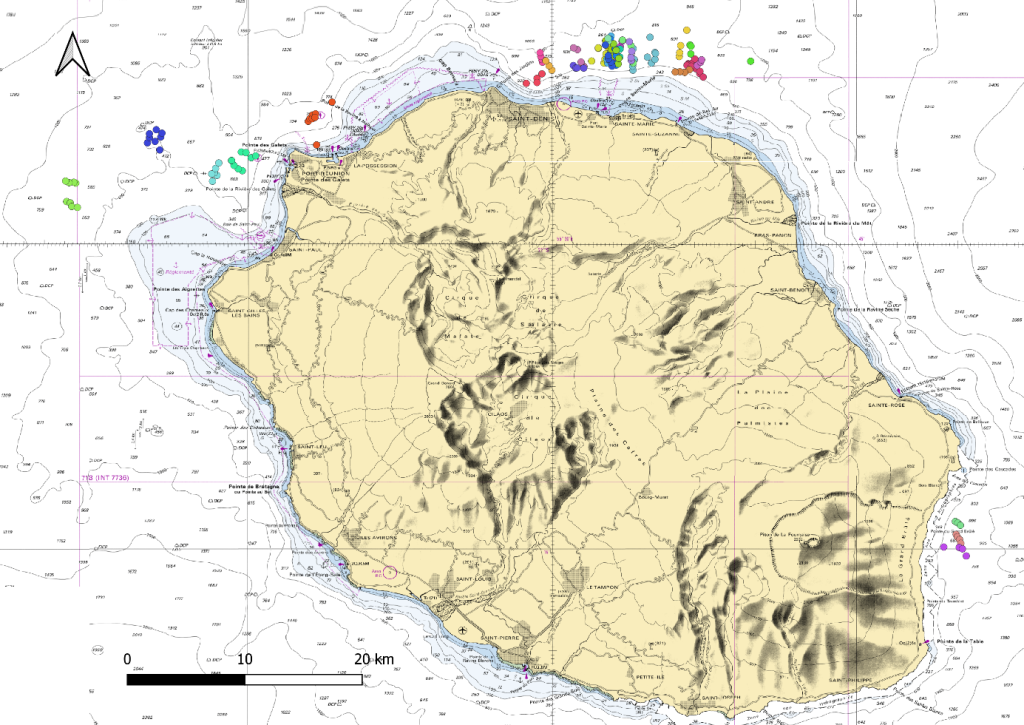
- ➔ Évaluation de la présence de calmars autour de la Réunion dans 3 zones d’études : Sainte-Marie, Le Port, Sainte-Rose
- ➔ Évaluation de la ressource en termes de disponibilité saisonnière en effectuant 30 sorties réparties entre l’hiver et l’été austral
- ➔ Étude de l’habitat grâce à l’instrumentation de la ligne avec des capteurs de température-profondeur (TDR)
Ces opérations de pêche ont permis de pêcher 61 calmars : 60 encornets volants d’un poids moyen entre 3 et 5 kg; et 1 calmar rhomboïdal d’un poids moyen de 19,6 kg.
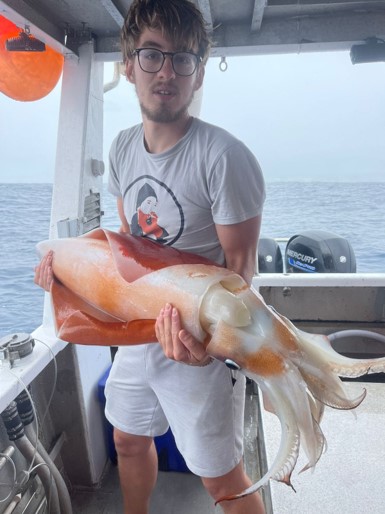
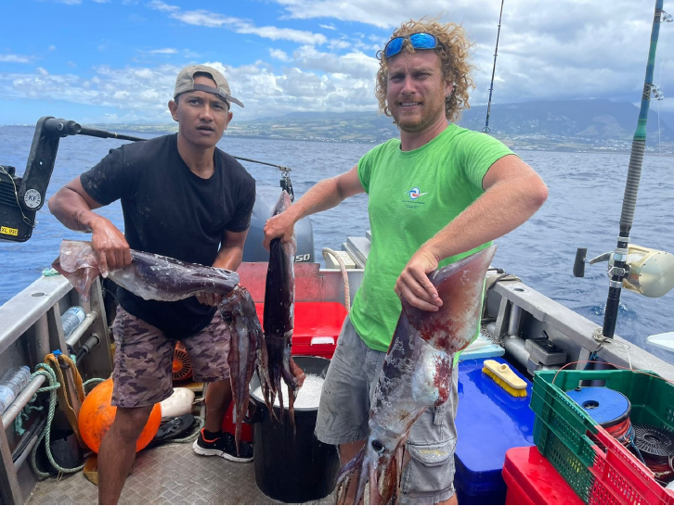
En comparaison avec des projets similaires menés dans le Pacifique par le SPC (Secrétariat de la Communauté du Pacifique), La Réunion a un taux de capture similaire: 11 calmars pêchés pour 100 turluttes. Cependant, la répartition par espèce est plus équilibrée dans les captures du Pacifique qu’à La Réunion car il y a presque autant d’encornet volant que de calmar rhomboïdal, alors que nous n’avons eu qu’un seul spécimen de calmer rhomboïdal. Les tests réalisés aux Fidji, en Nouvelle-Calédonie, à Tonga, aux îles Cook et en Polynésie française sont présentés dans la SPC Fisheries Newsletter n°144 . Afin de pouvoir réellement comparer ces tests, il faudrait augmenter l’effort de pêche à La Réunion, en multipliant les sites.
Valorisation des contenus stomacaux des échantillonneurs biologiques pour étudier la diversité de calmars à La Réunion
Les prédateurs supérieurs, comme les thons, l’espadon, ou les requins fréquentent les mêmes zones mais se nourrissent de proies de tailles et d’espèces variables. Ainsi l’étude des proies ingérées permet d’observer différentes espèces de calmars présentes autour de la Réunion selon les habitudes alimentaires de ces prédateurs. Les parties dures non digérées comme les becs de calmars permettent d’identifier les espèces, ou au moins le genre.
🦑
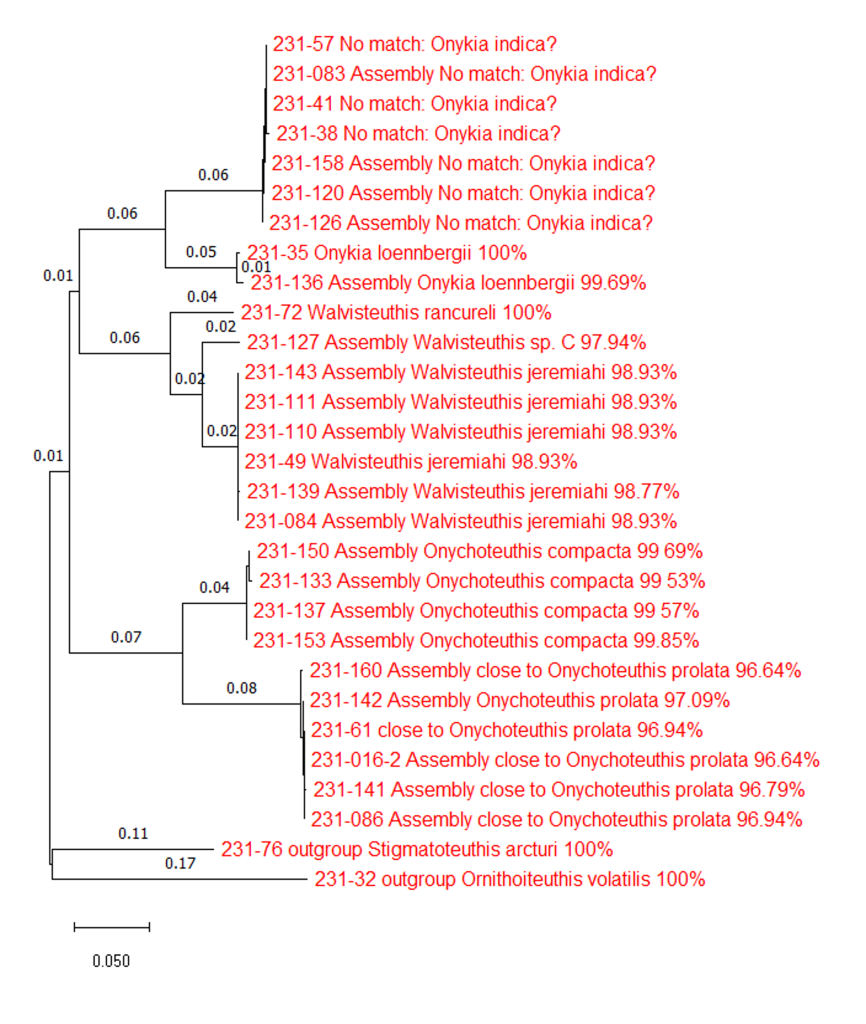
Cette étude a donc permis d’établir une liste faunistique des céphalopodes de La Réunion (voir ci-dessous), une première !
Les analyses génétiques par barcoding ont ainsi identifié 29 espèces de céphalopodes. 8 d’entre elles n’avaient jamais été recensées dans l’océan Indien mais en zone Atlantique, montrant que ces deux océans sont interconnectés. De même, deux espèces connues dans l’océan Pacifique ont été découvertes autour de la Réunion.
Ces résultats très encourageants représentent ainsi une avancée majeure pour la science et l’étude de la biodiversité réunionnaise.